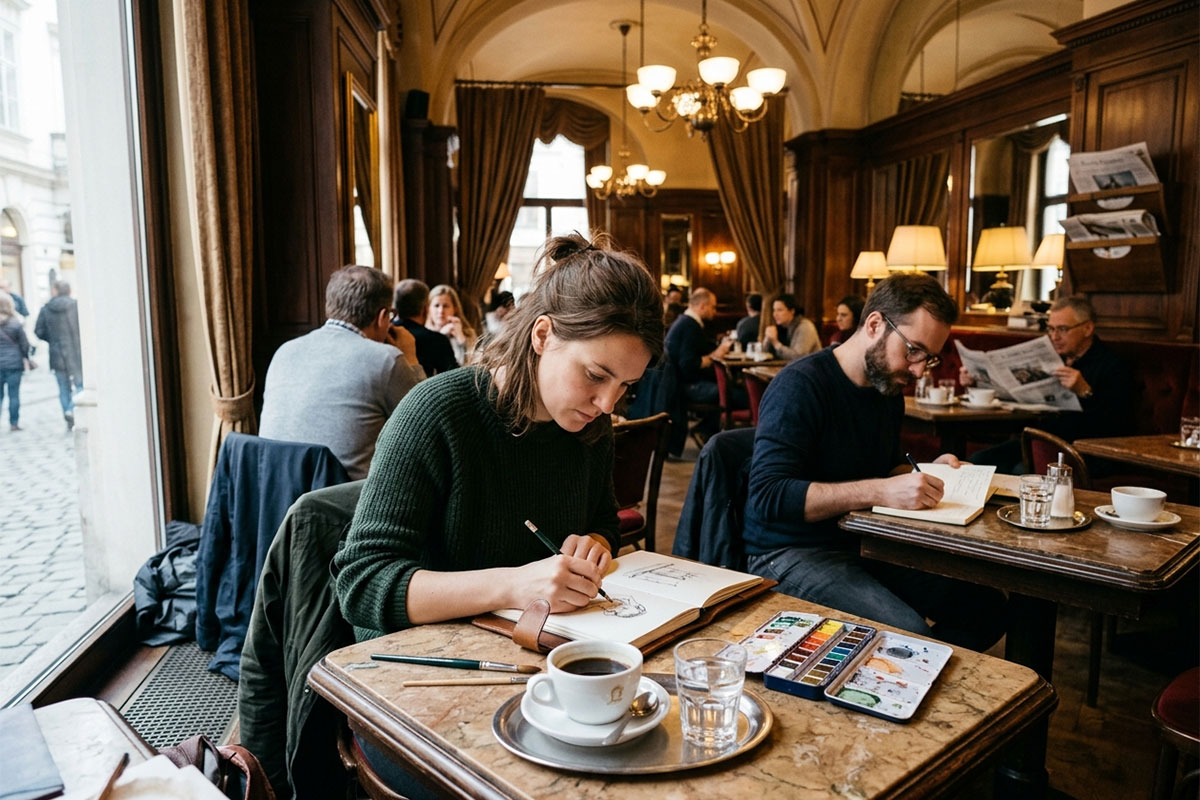
Stepping into a traditional Viennese coffeehouse is like walking onto a stage set that has remained unchanged for over a century. The air is thick with the aroma of roasted beans and fresh pastries, the newspapers rustle on their wooden sticks, and the marble tables seem to whisper secrets of the past. For the modern traveler visiting Vienna in January 2026, these spaces offer more than just a reprieve from the winter chill or a caffeine fix. They represent the physical and spiritual home of one of the most profound cultural explosions in European history. It was here, amidst the clinking of silver spoons and the haze of tobacco smoke, that the boundaries of art, literature, and thought were pushed, pulled, and ultimately redrawn.
To understand the artistic legacy of Vienna, one must understand that the coffeehouse was never merely a place to drink coffee. It was a democratic club, an extended living room, and a sanctuary for the creative soul. In the late 19th and early 20th centuries, housing in Vienna was often cramped, cold, and poorly lit. The coffeehouse offered warmth, light, elegance, and, perhaps most importantly, company. For the price of a single Melange, an artist could stay all day, access international newspapers, and engage in heated debates with peers. This unique social contract allowed penniless writers and painters to exist and create, fostering an environment where cross-pollination between disciplines wasn't just possible; it was inevitable.
The Living Room of the Avant-Garde
The concept of the coffeehouse as a "second home" was crucial for the development of the Viennese avant-garde. Unlike the salons of Paris, which were often invitation-only and hosted by the wealthy, the Viennese café was open to anyone. This accessibility meant that an aspiring painter could sit a few tables away from a renowned architect or a controversial playwright. The lack of hierarchy encouraged a free flow of ideas that shattered traditional artistic conventions. It was a place where the rigidity of the Habsburg Empire clashed with the radical ideas of the coming modern age.
Within these velvet-upholstered walls, the solitary act of creation became a communal experience. Artists sketched on the backs of menus, writers drafted entire chapters on marble tabletops, and architects debated the future of urban design over slices of Sachertorte. The constant hum of conversation provided a backdrop of intellectual fervor. This environment gave rise to a specific type of creative: the Kaffeehausliterat (coffeehouse writer), a term that describes authors who not only wrote in cafés but whose work was fundamentally shaped by the rhythm, observations, and interactions found within them.
Key Figures and Their Haunts
The relationship between specific artists and their preferred cafés is legendary. These venues were not interchangeable; each had its own distinct character, political leaning, and clientele. Understanding where these figures spent their time helps us map the intellectual geography of the city during the Fin de siècle era.
- Peter Altenberg: Perhaps the ultimate coffeehouse poet, Altenberg famously had his mail delivered to Café Central. He treated the café as his office and living room, sketching vignettes of Viennese life that captured the soul of the city.
- Gustav Klimt: Before he became the face of Austrian art, Klimt and his contemporaries frequented Café Museum. Its stark, modern interior designed by Adolf Loos appealed to their desire to strip away the excessive ornamentation of the past.
- Egon Schiele: The provocative expressionist was known to frequent various establishments, using the café setting to observe the human form and social interactions, which later translated into his raw and emotional sketches.
- Stefan Zweig: The celebrated author vividly described the coffeehouse education of his youth, noting that it was the true university for his generation, where they learned more from newspapers and debates than from textbooks.
The Birth of the Secession Movement
One cannot discuss Viennese art without mentioning the Secession movement, and the coffeehouse played a pivotal role in its inception. The conservative Academy of Fine Arts held a monopoly on artistic taste, favoring historical realism and classical themes. A group of rebellious artists, led by Gustav Klimt, sought to break free from these constraints. Their revolutionary ideas were not formed in sterile boardrooms but were hatched during long, caffeine-fueled nights in venues like the Café Sperl and Café Museum.
The Café Museum, opened in 1899, became known as "Café Nihilism" due to its minimalist design. It was the physical embodiment of the Modernist aesthetic the Secessionists championed. Here, the ornate clutter of the Victorian era was rejected in favor of clean lines and functionality. The architecture of the café itself reinforced the artistic philosophy of its patrons. It was in these spaces that the plans for the iconic Secession Building were drafted, and the motto "To every age its art, to every art its freedom" became a rallying cry.
Comparing the Creative Hubs
To truly appreciate the diversity of the scene, it is helpful to look at how different cafés catered to different slices of the intelligentsia. The table below illustrates the unique roles these venues played in Vienna's cultural ecosystem.
| Coffeehouse | Primary Clientele | Atmosphere & Significance |
| Café Central | Intellectuals, Revolutionaries, Writers | Grand Venetian style. The meeting place for Freud, Trotsky, and Altenberg. A hub for political and psychoanalytical discourse. |
| Café Museum | Painters, Architects, Designers | Minimalist and modern. The headquarters for the Secessionists and proponents of Modernism like Klimt and Loos. |
| Café Hawelka | Bohemians, Post-War Artists | Dark, smoky, and intimate. Became the center of the artistic revival after WWII, maintaining the tradition for a new generation. |
| Café Sperl | Musicians, Military Officers, Traditionalists | Preserved the "old Vienna" vibe. A place where operetta composers and painters mixed with the established bourgeoisie. |
Literature and the Art of Observation
While painters focused on visual revolution, writers used the coffeehouse as a laboratory for language. The genre of "Coffeehouse Literature" is unique to this region. It is characterized by a specific observational style—witty, slightly detached, yet deeply human. Writers sat for hours, watching the drama of daily life unfold: the lovers quarreling in the corner, the businessman reading the stock market news, the waiter's distinct hierarchy.
This constant observation honed the skills of writers like Karl Kraus and Arthur Schnitzler. They didn't just write in the café; they wrote about the world through the lens of the café window. The fragmentation of modern life, a key theme in 20th-century literature, was perfectly mirrored in the fragmented conversations and shifting crowds of the coffeehouse. The noise and bustle forced writers to develop a intense focus, resulting in works that were concise, sharp, and psychologically penetrating.
The Legacy in Modern Vienna
Today, in 2026, the Viennese coffeehouse culture is recognized as an Intangible Cultural Heritage by UNESCO. However, for the art lover visiting the city, these places are not mere museums. They remain active social spaces. While the smoke has cleared and the faces have changed, the fundamental purpose remains the same: to provide a space for time to stand still.
When you sit in a velvet booth at Café Central or admire the lighting in Café Museum, you are participating in a ritual that fueled the creative output of a century. The influence of these venues on art was not just about providing a table and a chair; it was about providing a community. It proved that creativity thrives on connection, debate, and the simple human need to belong. For the traveler, drinking a coffee in Vienna is an act of communion with the ghosts of Klimt, Freud, and Zweig, acknowledging that great art is often born from the simple pleasure of conversation.