Walking through the streets of Vienna in January 2026, the crisp winter air seems to sharpen the intricate details of the city’s skyline. Vienna is more than just a repository of imperial history; it is a living museum of architectural daring and structural ingenuity. While visitors are often captivated by the sheer opulence of the Habsburg residences, the true story lies in the masonry, the engineering, and the creative vision that made these structures possible. These palaces were not merely built to house monarchs; they were constructed to defy the limitations of their eras, serving as laboratories for artistic and technical experimentation that would influence European architecture for centuries. To understand Vienna is to look beyond the gold leaf and see the revolutionary blueprints beneath.
The Baroque Explosion: Redefining Space and Light
The transformation of Vienna from a medieval fortress city into a sprawling imperial capital began in earnest after the lifting of the Ottoman siege in 1683. This geopolitical shift allowed architects to dream bigger, moving away from purely defensive structures to open, expansive designs. The Baroque era brought with it an obsession with light, perspective, and theatricality. Architects like Johann Bernhard Fischer von Erlach and Johann Lukas von Hildebrandt did not just design buildings; they manipulated space to create emotional responses. They utilized the concept of the Gesamtkunstwerk—a total work of art—where landscape, architecture, and interior design were fused into a singular, cohesive vision.
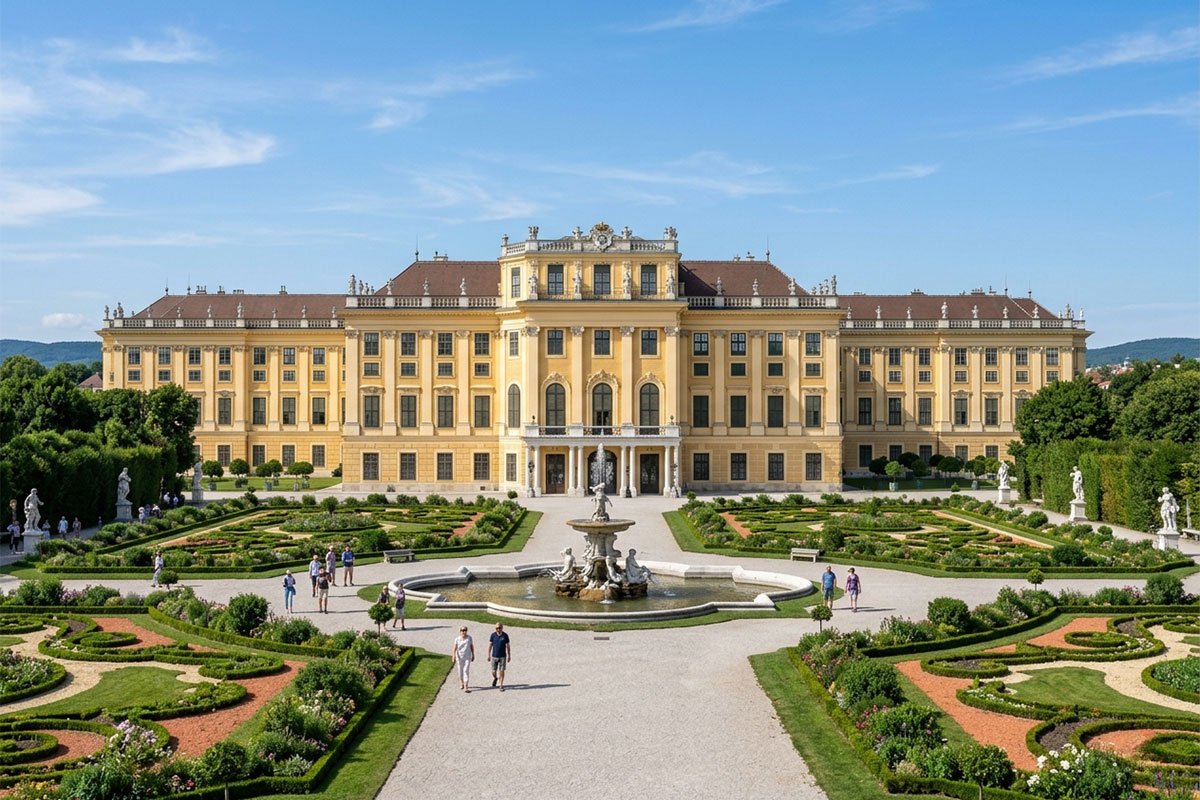
Schönbrunn Palace stands as the ultimate example of this innovative integration. Originally envisioned as a hunting lodge, its evolution into a summer residence required a mastery of scale that was unprecedented in Austria. The innovation here lies in the symmetry and the visual axis. The architects designed the palace to act as a seamless extension of the gardens, utilizing large glass windows—a luxury and a technical challenge at the time—to dissolve the barriers between the interior state rooms and the exterior nature. This was a radical departure from the thick-walled, fortress-like castles of the past, requiring advanced structural load-bearing techniques to support the expansive roofs while allowing for light-flooded galleries.
The Belvedere: Mastering Terrain and Perspective
If Schönbrunn was about scale, the Belvedere was a masterclass in topographical engineering. Built for Prince Eugene of Savoy, the complex consists of two palaces, the Upper and Lower Belvedere, connected by a sloping garden. The architectural genius here is found in how Hildebrandt utilized the natural incline of the land. He created a visual hierarchy where the Upper Belvedere seems to float above the city when viewed from the bottom. This required precise mathematical calculations regarding perspective and elevation.
The structural innovation of the Upper Belvedere is particularly note-worthy for its pavilion-like structure. Unlike the solid, blocky palaces of the Renaissance, the Belvedere is composed of distinct wings with varying roof heights, creating a dynamic silhouette that changes as the sun moves across the sky. The central Marble Hall is an engineering feat of its own, featuring a vaulted ceiling that supports a heavy roof while maintaining an airy, spacious interior atmosphere, achieved through a complex system of hidden buttresses and trusses.
The Hofburg: A Timeline of Structural Evolution
Unlike other European palaces built in a single stylistic burst, the Hofburg is a sprawling complex that grew organically over 600 years. It is a chaotic yet harmonious textbook of architectural history. Walking from the Swiss Wing to the Neue Burg is like time-traveling through the evolution of construction techniques. The innovation here is not in a single design, but in the adaptive reuse and expansion of existing structures. Architects had to constantly invent ways to connect new wings to old ones without compromising structural integrity or aesthetic flow.
The following table illustrates the diverse architectural eras and the specific innovations associated with different wings of the Hofburg complex:
| Wing / Area | Primary Era | Architectural Innovation |
| Swiss Wing (Schweizertrakt) | Late Gothic / Renaissance | Fortification integration; transition from defensive moat systems to residential courtyards. |
| Amalienburg | Late Renaissance | Introduction of the distinct clock tower mechanism and simplified facade symmetry. |
| Imperial Chancellery Wing | High Baroque | Monumental sculptures integrated directly into the structural facade elements (Atlantes). |
| St. Michael's Wing | Neo-Baroque (19th Century) | Complex urban planning; creating a curved facade to shape the public square (Michaelerplatz). |
| Neue Burg | Historicism | Use of modern steel frameworks hidden behind classical stone facades to support massive scales. |
Hidden Techniques: Innovation Behind the Decor
While the exteriors of Vienna’s palaces command attention, the interiors reveal a different set of innovative techniques. The architects and craftsmen of the imperial era were constantly seeking ways to reduce costs while maximizing impact, leading to the development of material technologies that were ahead of their time. They needed to create environments that were not only beautiful but also habitable during the freezing Austrian winters. This necessity drove advancements in heating and material science that are often overlooked by the casual observer.
- Scagliola Technique: Real marble was expensive and heavy. Viennese artisans perfected Scagliola, a composite substance made from selenite, glue, and pigments. This allowed them to create columns and architectural features that looked identical to marble but were lighter and could be molded into complex shapes that stone cutting could not achieve.
- Trompe-l'œil Ceilings: To make rooms feel larger and ceilings higher, painters worked with architects to create optical illusions. This wasn't just art; it was a mathematical application of perspective on curved surfaces, requiring precise geometric planning to ensure the illusion held from the viewer's standing point.
- Advanced Heating Systems: By the 18th and 19th centuries, palaces began incorporating intricate ceramic stove systems (Kachelofen) that were engineering marvels of thermal retention. These stoves were fed from hidden corridors behind the walls so that servants would not disturb the royals, representing an early form of zoned heating and service infrastructure.
Beyond the Main Palaces: Palais Liechtenstein and Palais Auersperg
While Schönbrunn, Belvedere, and Hofburg rightfully dominate discussions of Viennese palace architecture, it's important to acknowledge the contributions of other significant structures. Palais Liechtenstein, for example, showcases an early and influential example of Baroque architecture in Vienna, predating some of the better-known palaces. Its opulent interiors and impressive art collection reflect the wealth and power of the Liechtenstein family. Similarly, Palais Auersperg, with its stunning gardens and grand ballroom, played a crucial role in Viennese social life and hosted numerous important historical events. These palaces, though often less frequented by tourists, offer valuable insights into the diverse architectural landscape of Vienna.
From Imperial Residence to Urban Blueprint
The architectural language developed in these palaces eventually spilled out onto the streets of Vienna, particularly during the construction of the Ringstraße in the mid-19th century. The techniques refined in the Hofburg and Belvedere—such as the piano nobile (principal floor), the grand staircases, and the rhythmic facades—were adopted by the rising bourgeoisie for their own "Palais." This democratization of palace architecture created the cohesive visual identity that Vienna possesses today. It was a shift from architecture as a symbol of divine right to architecture as a statement of civic pride and cultural heritage.
As you explore these monumental structures, try to look past the gold leaf and the velvet ropes. Look at the curve of a ceiling, the span of a window, and the way a building sits against the horizon. These are the silent testaments to the architects who dared to push the boundaries of physics and aesthetics. Vienna’s palaces are not just beautiful; they are enduring proofs of human ingenuity, standing tall as we move through 2026, reminding us that true innovation is timeless.