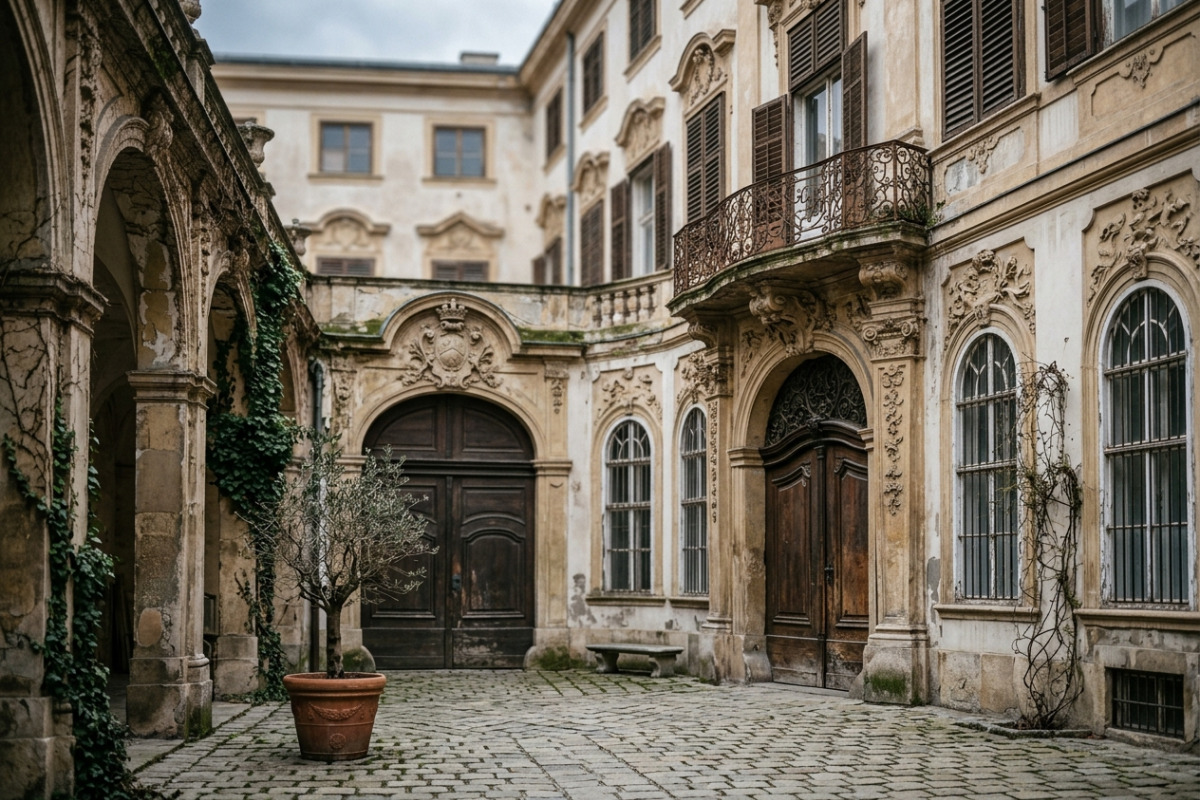
While the Hofburg Palace dazzles visitors with its imperial apartments and ornate museums, its hidden courtyards tell a quieter story. Nestled between centuries-old wings and arcaded passages, these secluded spaces offer a glimpse into the palace’s layered past, a world of courtiers, servants, and secret meetings behind the grandeur of empire. Exploring the Hofburg courtyards is like stepping into a time capsule of imperial Vienna.
Swiss Courtyard (Schweizerhof)
The Swiss Courtyard is the oldest part of the Hofburg, dating back to the 13th century. Named after the Swiss Guard who once protected the palace, it was the original heart of the medieval fortress. Today, visitors can admire its mix of late Gothic and early Renaissance arcades and the Swiss Gate (Schweizertor), adorned with Emperor Ferdinand I’s coat of arms. It offers a perfect introduction to the deeper layers of the palace complex.
In der Burg (Inner Courtyard)
Surrounded by historic residential and administrative wings, the Inner Courtyard formed one of the central spaces of daily life in the Hofburg. At its center stands the Monument to Emperor Francis I, one of Vienna’s most photographed statues. Visit early in the morning, and you may find a rare moment of serenity, footsteps echoing across the cobblestones where ministers and courtiers once hurried through the palace corridors.
Amalienhof: The Emperor’s Private Domain
The Amalienhof Courtyard takes its name from the Amalienburg, a wing traditionally associated with Empress Amalie Wilhelmine. Its façade is marked by a 16th-century clock tower topped with a green dome and the Habsburg double-headed eagle. Nearby were some of the residential and working rooms used by Emperor Franz Joseph, giving this area an intimate character where the routines of daily life met the duties of imperial rule.
Michaelerplatz Entrance
Michaelerplatz is the grand entrance to the Hofburg complex, framed by the dramatic St. Michael’s Wing and crowned with a striking Neo-Baroque dome added in the late 19th century. Despite its grandeur, hidden details abound from swirling stucco reliefs symbolizing power and wisdom to the cobblestones leading toward the Spanish Riding School. Stand at its center to capture one of Vienna’s most cinematic palace perspectives.
Burggarten Passage
Tucked behind the palace, a small walkway links the Hofburg grounds with the Burggarten, one of Vienna’s most beloved public parks. Once part of the imperial garden used by Emperor Franz Joseph, the area now leads visitors toward the glass-domed Palm House and the Butterfly House, a charming blend of history and nature. It’s an atmospheric spot for a peaceful break or a candid photograph away from the crowds.
Exploring Hofburg’s Forgotten Spaces
The courtyards of Hofburg are open to the public and can be explored freely on foot. For a deeper experience, combine your walk with entry to the Hofburg Palace’s official tours, which include access to the Imperial Apartments and Sisi Museum. Each visit reveals new layers of Vienna’s imperial story, not just in its grand halls, but in the quiet corners where history truly lingers.
In these hidden courtyards, the grandeur of empire gives way to whispers of daily life, making Hofburg Palace not only a monument of power but also a mosaic of human moments frozen in time.