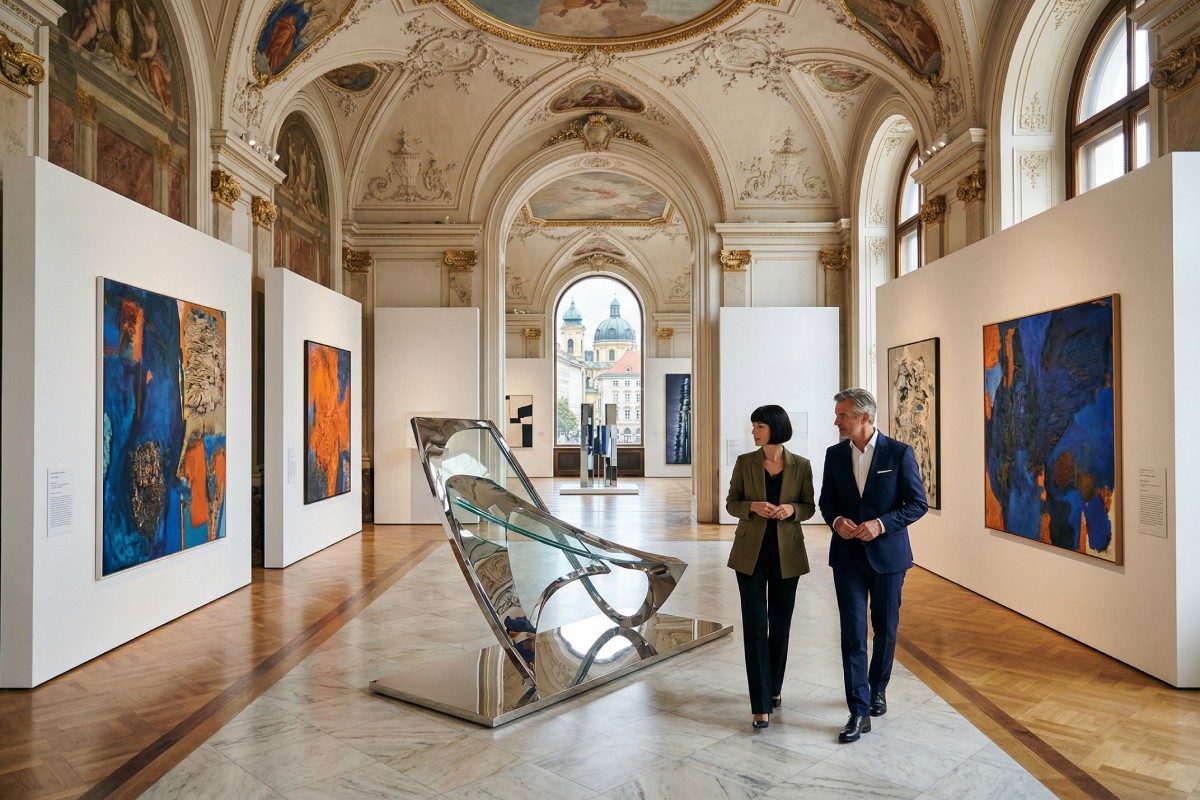
When most travelers imagine Vienna, their minds often drift to the rhythmic clip-clop of fiakers on cobblestones, the grandeur of the Habsburg palaces, or the steam rising from a cup of Melange in a century-old coffee house. However, as we move through January 2026, the Austrian capital is solidifying its reputation as a powerhouse of the contemporary art world. What makes Vienna truly unique is not just the art itself, but where it is housed. Here, the avant-garde does not erase the past; it inhabits it. The city’s contemporary art scene is a fascinating dialogue between the imperial history of the buildings and the radical modernity of the works displayed within them.
Walking through Vienna’s art districts offers a sensory experience that is distinct from the sterile 'white cube' galleries found in New York or London. In Vienna, you are just as likely to view a provocative video installation beneath a Baroque fresco as you are to see minimalist sculpture housed in a converted imperial stable. This juxtaposition creates a tension that enhances the artwork, forcing the viewer to consider the passage of time. The architecture provides context, grounding the fleeting nature of contemporary trends in centuries of cultural heritage.
The MuseumsQuartier: A Baroque Complex Reimagined
Nowhere is this blend of old and new more palpable than at the MuseumsQuartier (MQ). Once the imperial stables for the Habsburg monarchy, this massive complex is now one of the world's largest districts for contemporary art and culture. Walking into the main courtyard, you are immediately struck by the architectural contrast. The original 18th-century structures, painted in imperial yellow, embrace two modern monoliths: the white limestone of the Leopold Museum and the dark basalt of the MUMOK (Museum of Modern Art Ludwig Foundation). This visual clash is intentional and sets the stage for what lies inside.
The MUMOK, in particular, challenges the viewer's perception of space. Its dark, fortress-like exterior houses a vibrant collection of Pop Art, Fluxus, and Photorealism. As you ascend its glass elevators, you catch glimpses of the historic skyline outside, creating a constant visual reminder of where you are. The experience here is about layers; the deeper you go into the modern collections, the more you appreciate the historic shell that surrounds the district. It is a testament to Vienna's ability to evolve without discarding its identity.
Albertina Modern: The Renaissance of the Künstlerhaus
Another prime example of this historical synthesis is the Albertina Modern. Housed in the Künstlerhaus on Karlsplatz, this venue represents a triumph of restoration and repurposing. The building itself, constructed in the 1860s during the Ringstraße era, was originally designed to be a center for Austrian artists. After years of renovation, it reopened to become a premier location for post-1945 art. The restoration preserved the historic terrazzo floors and the grand staircases, yet the exhibition spaces have been equipped with state-of-the-art lighting and climate control to host delicate contemporary works.
Visiting the Albertina Modern feels like walking through a timeline of Austrian identity. The exhibitions often focus on Austrian artists who have shaped the international scene, such as Maria Lassnig or Arnulf Rainer. Seeing these sometimes chaotic, abstract, or politically charged works against the backdrop of 19th-century academic architecture creates a powerful narrative. It suggests that the rebellious spirit of contemporary art is the natural successor to the classical traditions that built the city.
Schleifmühlgasse: The Gritty Side of Elegance
If the MuseumsQuartier and Albertina represent the institutional side of Vienna's art scene, the galleries along Schleifmühlgasse in the 4th district represent its independent spirit. This area, located near the famous Naschmarkt, has transformed from a quiet neighborhood into a trendy gallery hub. Here, the spaces are smaller, more intimate, and often located in old residential buildings or former shops. The charm lies in the unpolished nature of the architecture—creaking wooden floors, high ceilings with decorative stucco, and large street-facing windows that blur the line between the gallery and the city.
Visitors exploring this district in early 2026 will find a diverse array of galleries that champion emerging talent. The experience here is personal. It is not uncommon to run into the artists themselves or to have a long conversation with a gallery owner who is passionate about the local scene. Key characteristics of the Schleifmühlgasse experience include:
- Intimate Settings: Art is displayed in spaces that feel like living rooms, making the viewing experience less intimidating and more personal.
- Architectural Details: Look for original Viennese architectural elements like 'Altbau' double doors and herringbone parquet flooring that frame modern paintings.
- Community Vibe: The proximity of galleries allows for an easy art walk, often ending in one of the neighborhood's hip cafés.
- Experimental Art: These spaces are often more willing to take risks with installation art and performance pieces than the larger museums.
The Secession: The Original Rebel
No discussion of Vienna's art scene is complete without mentioning the Secession Building. While it is a historical landmark, built in 1897, it was the birthplace of Vienna's original modern art movement led by Gustav Klimt. Today, it remains an artist-run institution dedicated solely to contemporary art. The building itself is an Art Nouveau masterpiece, famous for its golden cabbage dome, but the interior is surprisingly stark and flexible. The motto above the entrance, "To every age its art, to art its freedom," is as relevant today as it was over a century ago.
The exhibitions at the Secession are known for being site-specific. Artists are invited to transform the main hall, often engaging with the architecture in radical ways. This creates a unique continuity; the building was created to break rules, and the artists exhibiting there today continue that tradition. Descending into the basement to see Klimt’s "Beethoven Frieze" and then returning upstairs to view a cutting-edge conceptual installation is a quintessential Viennese experience—a literal movement between the golden age of the past and the experimental present.
Comparing the Experience: Atmosphere and Focus
To help you navigate Vienna's diverse gallery landscape, here is a breakdown of what to expect in terms of atmosphere and artistic focus across different venues:
| Venue Type | Architectural Context | Artistic Focus | Visitor Vibe |
| MuseumsQuartier (MUMOK/Leopold) | Imperial Stables meets Modernist Cubes | International Modernism, Pop Art, Austrian Expressionism | Grand, educational, and bustling with activity. |
| Albertina Modern | 19th-Century Ringstraße Palace | Post-1945 Art, Photography, Graphic Art | Elegant, polished, and historically rich. |
| Schleifmühlgasse Galleries | Converted Residential/Commercial Spaces | Emerging Artists, Experimental, Avant-Garde | Hip, intimate, and community-focused. |
| The Secession | Art Nouveau Temple | Site-specific Installations, Conceptual Art | Intellectual, quiet, and reverent. |
| WestLicht | Industrial Loft / Former Factory | Contemporary Photography, Camera History | relaxed, focused, and historically industrial. |
Redefining the Viewer's Experience
The magic of Vienna’s contemporary art scene lies in how these spaces redefine the act of looking. In a standard white-walled gallery, the outside world is excluded to focus attention solely on the object. In Vienna, the outside world—specifically the weight of history—is allowed in. The ornate molding on a ceiling might compete for attention with a neon sculpture, or the echo of a high-ceilinged room might become part of a sound installation. This lack of neutrality is a strength. It reminds us that art does not exist in a vacuum; it exists within the continuum of human history.
As you explore these galleries, take a moment to look away from the art and observe the space. Notice how the natural light filters through century-old windows, or how a modern steel staircase cuts through a stone foyer. These architectural conversations are what elevate Vienna from a mere repository of old masters to a vibrant, living capital of culture. Whether you are an avid collector or a casual observer, the city invites you to witness the beautiful collision of the past and the future.