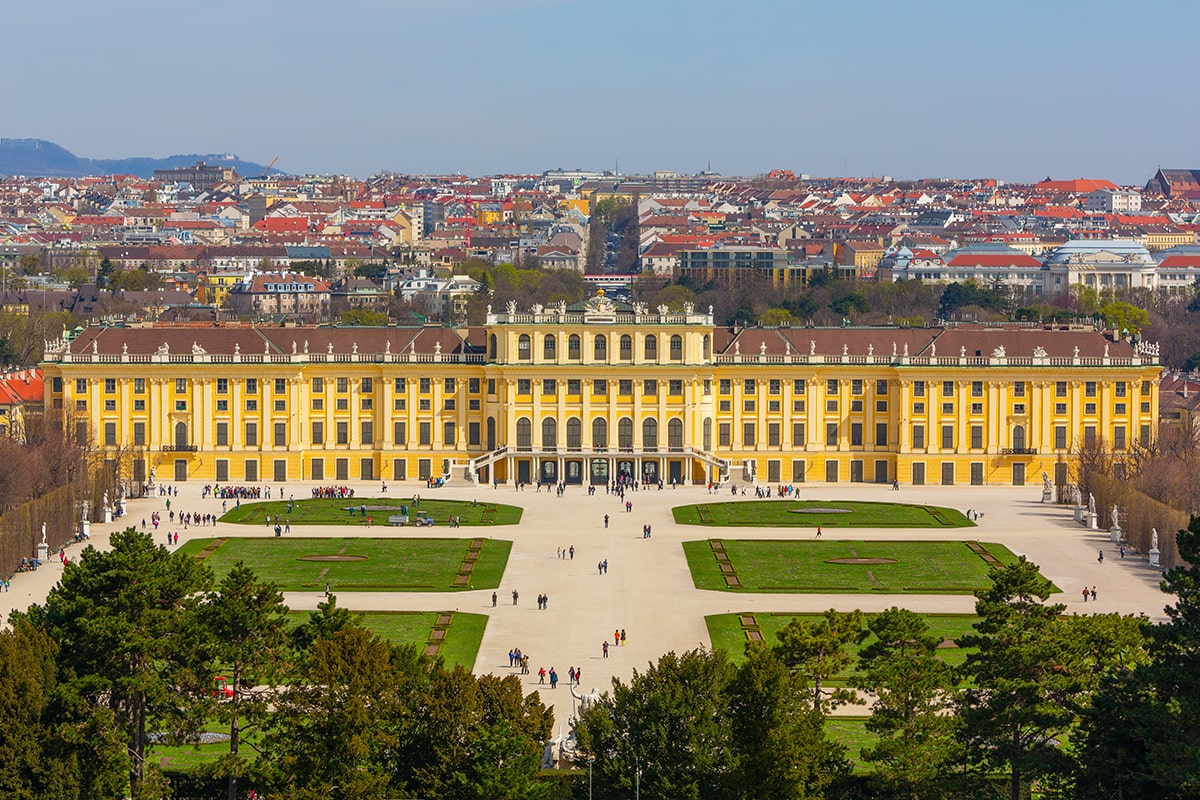
The magnificent Schönbrunn Palace has witnessed the rise and fall of empires, the lives of emperors and empresses, and centuries of artistic achievement. What began as a modest hunting lodge in the 16th century eventually transformed into one of the most iconic symbols of Vienna, a palace that mirrors the changing face of Austria’s history.
The Origins: From Hunting Lodge to Royal Retreat
The site of Schönbrunn first entered history in 1569 when Emperor Maximilian II purchased the land as an imperial hunting ground. The name “Schönbrunn,” meaning “beautiful spring,” refers to the natural water source discovered there. Early structures served as a quiet retreat for Habsburg royals escaping the formalities of court life in central Vienna.
The Baroque Transformation
In the late 17th century, Emperor Leopold I commissioned architect Johann Bernhard Fischer von Erlach to design a grand Baroque palace that could rival the splendor of Versailles. Though the original vision was scaled down, the resulting palace became a masterpiece of balance and elegance, complete with grand staircases, frescoed ceilings, and perfectly aligned gardens.
By the 1740s, Empress Maria Theresa transformed Schönbrunn into her favorite residence, adding Rococo-style interiors, luxurious furnishings, and spaces designed for concerts and diplomacy. It was under her reign that the palace truly came to life as the heart of Habsburg imperial culture.
The Age of Empire and Napoleon’s Visit
Schönbrunn’s political significance extended beyond Austria’s borders. In 1805 and 1809, Napoleon Bonaparte used the palace as his headquarters during his military campaigns. Later, Emperor Franz Joseph I was born here and spent most of his 68-year reign living at the palace, making it a central hub of imperial governance.
The palace also hosted important diplomatic events and royal celebrations, serving as a stately backdrop for the Habsburgs’ power and refinement throughout the 19th century.
The Fall of the Monarchy and Modern Times
After World War I and the end of the Habsburg monarchy, Schönbrunn became state property. Despite the political upheaval, it remained a national treasure, carefully preserved and opened to the public as a museum. In 1996, UNESCO recognized the palace and its gardens as a World Heritage Site, celebrating it as a masterpiece of European Baroque architecture and cultural history.
Visiting Schönbrunn Palace Today
Today, Schönbrunn welcomes millions of visitors annually who come to walk through its imperial halls, admire the frescoed ceilings, and explore the vast gardens, fountains, and Gloriette viewpoint. You can book your preferred entry time directly from our Schönbrunn Palace ticket page for a smooth, skip-the-line experience.
Every corner of Schönbrunn Palace tells a story from royal ambition and artistic triumph to cultural legacy. Visiting today means stepping into centuries of history that continue to define Vienna’s imperial charm.